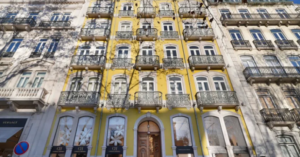
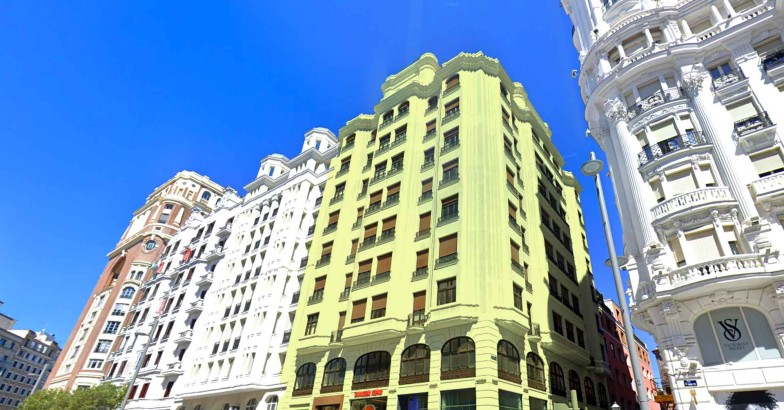
The building currently houses offices on the upper floors and retail and leisure venues on the lower floors.
Madrid’s municipal governing board has given preliminary approval to a Special Plan submitted by the owner of 40 Gran Vía. The plan would allow the building to be used exclusively as a hotel and set conditions to safeguard its architectural and historic features.
Designed by José Miguel de la Quadra-Salcedo
Architect José Miguel de la Quadra-Salcedo designed the building in 1926 with the possibility of housing a hotel. The Special Plan revives that idea and aims to restore the original architectural features as the architect intended.
Later additions that altered the building’s design will be removed to recover much of its original layout and appearance.
Madrid’s General Urban Development Plan gives the building Level 2 structural protection. It also lies within the historic district of Madrid, designated a Site of Cultural Interest, and within the city’s historic archaeological protection zone.
Restoring the courtyards, roof and façade
The building lies within the protected surroundings of the Capitol Building and the Church of San Martín, both designated Sites of Cultural Interest. It is also within the buffer zone of the Landscape of Light, a UNESCO World Heritage Site.
The Special Plan calls for restoring the courtyards, roof and façade to improve how the building fits into its surroundings and preserve its historic character.
The proposal would remove part of the mezzanine and demolish several later additions on the top floors. The work would reduce the building’s total floor area from 5,731 to 5,116 square meters.
The hotel would have an entrance lobby on the ground floor, with guest rooms and shared spaces from the second floor upward. The two basement levels would house building systems and support services.
The plan received favorable reports from Madrid City Council’s Commission for the Protection of Historic, Artistic and Natural Heritage and the Community of Madrid’s Local Historic Heritage Commission. It also received a report confirming those findings from the regional Directorate-General for Cultural Heritage and the Office for the Spanish Language.
Following preliminary approval, the plan will be published in the Official Gazette of the Community of Madrid, opening a one-month period for public review and formal comments.