
Spain’s property valuation industry association expects both home prices and rents to keep rising. It estimates that mortgage payments now account for nearly 38% of disposable income.
Housing costs in Spain are expected to keep rising over the next few years. Supply remains scarce, and buyers are snapping up virtually every property that comes onto the market. The industry association sees little prospect of near-term relief and says the market may begin to stabilize in 2028 at the earliest.
That is one of the main findings of the 24th edition of the Valuation Observatory report from the Spanish Association for Value Analysis (AEV). Professor Paloma Taltavull contributed to the report alongside a panel of 13 experts drawn from the association’s membership and outside economists.
According to the report, a shortage of completed homes has pushed prices for new and existing properties up at nearly the same pace, with year-on-year increases reaching 15%. The report rules out a broad market correction and expects the adjustment to come through demand, as rising prices and worsening affordability push more households out of the market.
“The shortage of homes has become one of the main sources of pressure on the market. Buyers continue to absorb the available supply of both new and existing homes, making it difficult for prices to stabilize in the short term,” says Jorge Dolç, secretary general of the AEV. “We need to bring more homes onto the market year after year. That means addressing land availability, development timelines, the construction sector’s capacity and the renovation of existing homes together. Until supply increases, affordability will continue to shape the housing market.”
Homebuilding is failing to keep pace with demand
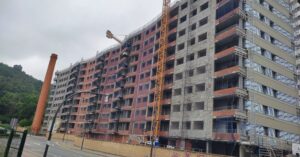
The report identifies the gap between housing demand and the number of homes coming onto the market as the central problem. Since 2022, Spain has added around 250,000 households a year, while only about 94,000 market-rate homes were completed in 2025. The Bank of Spain estimates a cumulative shortfall of 750,000 homes and expects it to exceed one million by 2028 if current trends continue. Bank of Spain housing shortfall forecast
Construction shows little sign of speeding up enough to close that gap. Spain’s economy is growing at around 2.5% and the construction sector’s gross value added is up 3%, yet only about 8,000 homes are completed each month, compared with roughly 12,000 construction starts.
The report expects fewer home sales, more young people delaying their move out of the family home, and buyers opting for smaller properties. Some demand is also expected to shift to outlying towns or less central provinces.
Buying a home takes a larger share of income as mortgage amounts hit a record
Higher home prices mean buyers need to borrow more. The average mortgage has reached €180,000, exceeding the previous nominal record set in 2007. Average mortgage figures
According to the report, mortgage payments now take up nearly 38% of disposable income, and buying a home costs the equivalent of 8.4 years of gross pay. The report says these levels exceed prudent affordability thresholds in major cities and coastal areas.
Rents are expected to keep rising
Pressure on the housing market is also carrying over into rentals. Rent growth has slowed to below 8% nationwide, but the experts say that slower growth has yet to make renting more affordable. They expect the underlying trend to continue in the near term.
Half of the panelists from within the association and all of the external experts warn that rents are still rising much faster than wages. As a result, more tenants are turning to alternatives such as sharing a home or renting a room.
Inherited homes and the growing role of foreign buyers
Property transfers through inheritance and growing international demand are also shaping Spain’s housing market.
According to the AEV report, inheritances now account for 20% of all transfers of property rights, with little effect on the supply of homes available on the market.
The experts say inherited properties cannot make up for a lack of new construction. Many stay in the family, are tied up in joint ownership or need renovation before they can be put on the market. Many are also in municipalities far from major cities and employment centers.
Foreign buyers who live in Spain have become an established source of demand, particularly in the Balearic Islands and the Valencian Community, where they now account for more than 30% of transactions. The report says their greater purchasing power gives them an advantage when supply is scarce, putting upward pressure on local prices and pushing Spanish buyers, including young people, toward areas farther out or into the rental market.